Lies, damn lies, and vaccines

This is how to undermine public trust in science.
We've all seen the just how hard the government and mainstream media are pushing the idea that 2 jabs are ineffective against this devastating Omicron variant and boosters will save the day. But what if I told you that they're out on a limb with that particular assertion, and it's there to see for anyone who bothers to read the science they cite?
And before you get the anti-anti-vaxxer pitchforks, let me explain why this annoys me:
- It's wrong to mislead the public
- It's worse to do it by suggesting "the science" or "the data" supports your position when it does not (even if both turn out to be separately correct)
- It undermines the other - good - arguments, and renders them vulnerable to attack by association
As for what I actually think is inconsistent between the government & media's account vs the science, the short version is:
- There isn't enough data to say anything with certainty, but the data which supports the chosen narrative has been cherry picked
- Other data points which were not cherry picked would suggest that
- The AZ vaccine makes you more vulnerable to Omicron than no vaccine at all
- You are better off not having the booster if you've had Pfizer recently
- I don't think the above points can be supported at this stage either; my point is to highlight that they're no less legitimate so maybe we shouldn't jump either way
- What data there is seems to suggest that how long protection lasts is a lot more significant than differences between variants
Now, I can sense the eye rolling from here - why am I writing a long post about the minutiae of exactly how far a couple of points in a single technical brief have been stretched? But the principles being broken here are important. This might not be the time it causes a practical problem, but eventually this sort of shenanigans will land us in a mess.
We are working up to a huge decision point for our society on what we collectively accept as the right way to balance individual liberty and the wellbeing of the many. Trust between different sides on polarising issues is already low and we can't afford to let a series of small but important half-truths mean that we've lost that debate before we have even started it.
If you want to know how I came to these conclusions, read on.
The claims
The headlines are full of claims that "two jabs bad, three jabs good":
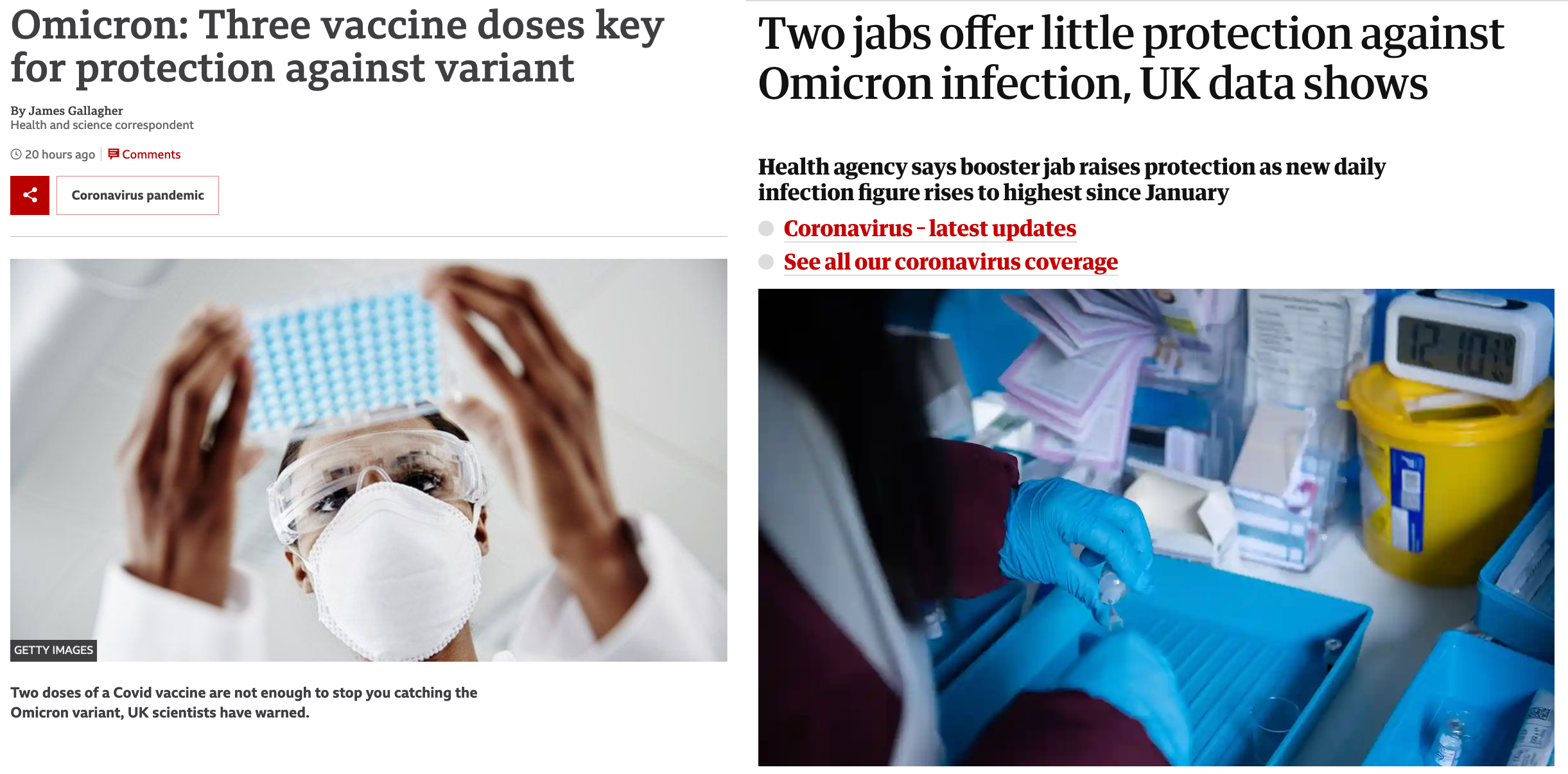
They all cite the same UKHSA technical briefing[1], and if you take the time to actually read it...then wonder why they got a distracted intern to work out how to present the data...then power through to understand what it actually says, it paints a somewhat different picture.
What the technical briefing actually says
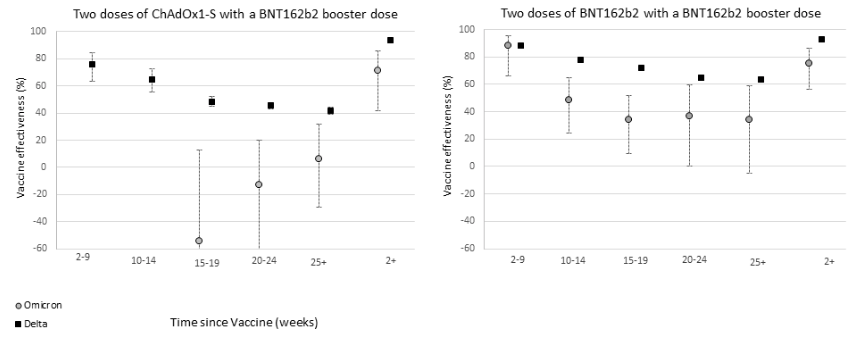
The critical information is figure 7 and the accompanying text (p20-22). Here's a few interesting observations about what you might think if you took this data at face value:
-
There are only two like-for-like comparisons possible: 2-9 weeks after your 2nd jab vs 3rd jab for AZ and Pfizer respectively, and they are completely inconsistent.
-
Your best protection from omicron is having had 2 Pfizer shots <10 weeks ago. I.e. if you wanted to jump to a conclusion from that one data point (please don't) then if you'd just had your second Pfizer, you should NOT take the booster (yet).
-
If you have had 2 AZ shots more recently than 25 weeks ago then you are significantly more at risk from omicron than if you hadn't had the vaccine.
-
For any given scenario, protection against omicron is less than against previous variants.
-
The protection against previous variants, and also against omicron for the all-Pfizer case decreases similarly over time.
4 & 5 are unsurprising, but 1-3 should be all over the news shouldn't they?
Q: Why aren't we seeing headlines like these?
After your booster you're less protected against Omicron than after your 2nd jab
Recent AZ jabbees made more vulnerable to Omicron
A: Because it doesn't fit the pre-determined narrative.
(reminder to put the pitchfork down)
I don't want to see those headlines either. The elephant in the room is that there just isn't sufficient data to be confident about anything. It really is based on very small samples (581 Omicron vs 56,439 Delta) Now, I don't mind having inconclusive data; it's still better than nothing. The problem is you can't just dismiss these worrying-if-true aspects then cherry pick something like "76% effective against Omicron" from the same flawed analysis.
This is mainly a problem of how the report is being used, rather than problems with the report itself. There are a few crimes of omission (like pointing out there are only 2 like-for-like 2 doses vs 3 doses data points), and the presentation is truly dreadful (that x-axis should make any self-respecting statistician want to grab their pitchfork). However, the report itself is reasonably transparent about the uncertainties and pitfalls of leaping to conclusions.
There's another key observation on p21/22:
With previous variants, vaccine effectiveness against severe disease, including hospitalisation and death, has been significantly higher than effectiveness against mild disease...It will be a few weeks before effectiveness against severe disease with Omicron can be estimated, however based on this experience, this is likely to be substantially higher...After the emergence of Delta in the UK, early estimates of vaccine effectiveness against mild infection after 2 doses of vaccine were substantially attenuated in comparison to alpha. Analysis of protection against hospitalisation however, showed no diminution of protection when comparing the 2 variants.
In other words, there is some precedent to believe there might be little or no difference in protection between 2 and 3 jabs in terms of protection against serious illness.
That's a pretty big omission for those making claims based on this report; and in my view a negligent one.
Is there a better way?
Yes. And it's simple. The reporting about the significance of this briefing really should have been something more like:
The dataset is so small we know the picture isn't reliable. There are some unusual results around those who have previously had the AZ vaccine, but there is also a consistent indication that while Omicron seems more resistant to the vaccines, that a reasonable level of protection can be achieved by having at least one Pfizer dose. We can't rely on any of these early observations, but will have a clearer picture in the next few weeks when there is more data, in particular around the impact on serious illness.
But that does panic the public or sell papers does it?
Consequences
Right now everyone's overly-focused on a particular variant and a particular booster. Soon it will be the next variant or next booster. There will be much talk of transmission and decreased protection against symptomatic disease, and little talk of protection against serious illness remaining high.
The longer we do this "one more variant; one more jab" dance, the longer we're avoiding the real question:
Do you want to have to take boosters twice a year indefinitely?
I can hear the cries now - why does it matter? We "know" more vaccine is the right answer, don't we? Well, the more you believe you're right, the less scared you should be of letting everyone see the full picture. And if you do want to persuade people that indefinite boosters are the way to go, you certainly won't do it with lies - even ones about data that won't ultimately matter.
It seems clear enough to me that getting 2 jabs into as many people as possible has had a dramatic positive impact on everyone's health. It also seems clear that for most people, getting an up to date jab is an effective way to increase their protection against Covid of all variants.
The problem is that being right overall won't help if you're caught in a lie. What if it turns out AZ actually does make people more vulnerable to Omicron? The anti-vaxxers would have a field day. It would undermine trust in perfectly sound arguments. The vaccine pushers could find themselves stood in front of a bus saying "AZ will save 350 million people from Omicron".